Sunday, 11 April 2021

Audeince Research: Focus Group

 Primary Audience 


AMAYA CONWAY

Age: 16

Gender: Female

Race: Hispanic, White

Psychographic: Mainstreamers and Succeeders

Location: Thorpe Bay, England

Interests: Reading, Baking, Singing 


MITCHELL ROGERS

Age: 17

Gender: Male

Race:  White

Psychographic: Explorers, Strugglers, Reformers  

Location: Eastwood, England 

Interests: Music, Rugby, Parties, Superheroes 


ASHNA KHODABUX

Age: 20

Gender: Female

Race: Brown 

Psychographic: Explorers and Reformers   

Location: Exeter, England 

Interests: Art, Jewellery Making, Shoes 


WILL WILSON

Age: 20

Gender: Male

Race: White

Psychographic: Reformers and Mainstreamers

Location:  Wales

Interests: Rugby, Gym, Cars 


ADNAAN KHODABUX

Age: 22

Gender: Male 

Race: Brown  

Psychographic: Reformer 

Location: Southend-On-Sea, England

Interests: Gaming 


ANWEN SLEATH

Age: 20

Gender: Female 

Race: White 

Location: Exeter, England / Wales 

Psychographic: Succeeders and Explorers 

Interests: Documentaries, Fashion, Art, Socialising 


Secondary Audience 


NABIL BACHRI

Age: 44

Gender: Male 

Race: Brown

Location: Southend-On-Sea, England 

Psychographic: Succeeders

Interests: Music, Sports and Cars 


JAMIE VINCENT 

Age: 13

Gender: Male

Race: British White

Location: Southend-On-Sea

Psychographic: Mainstreamer

Interests: Gaming and Drawing 


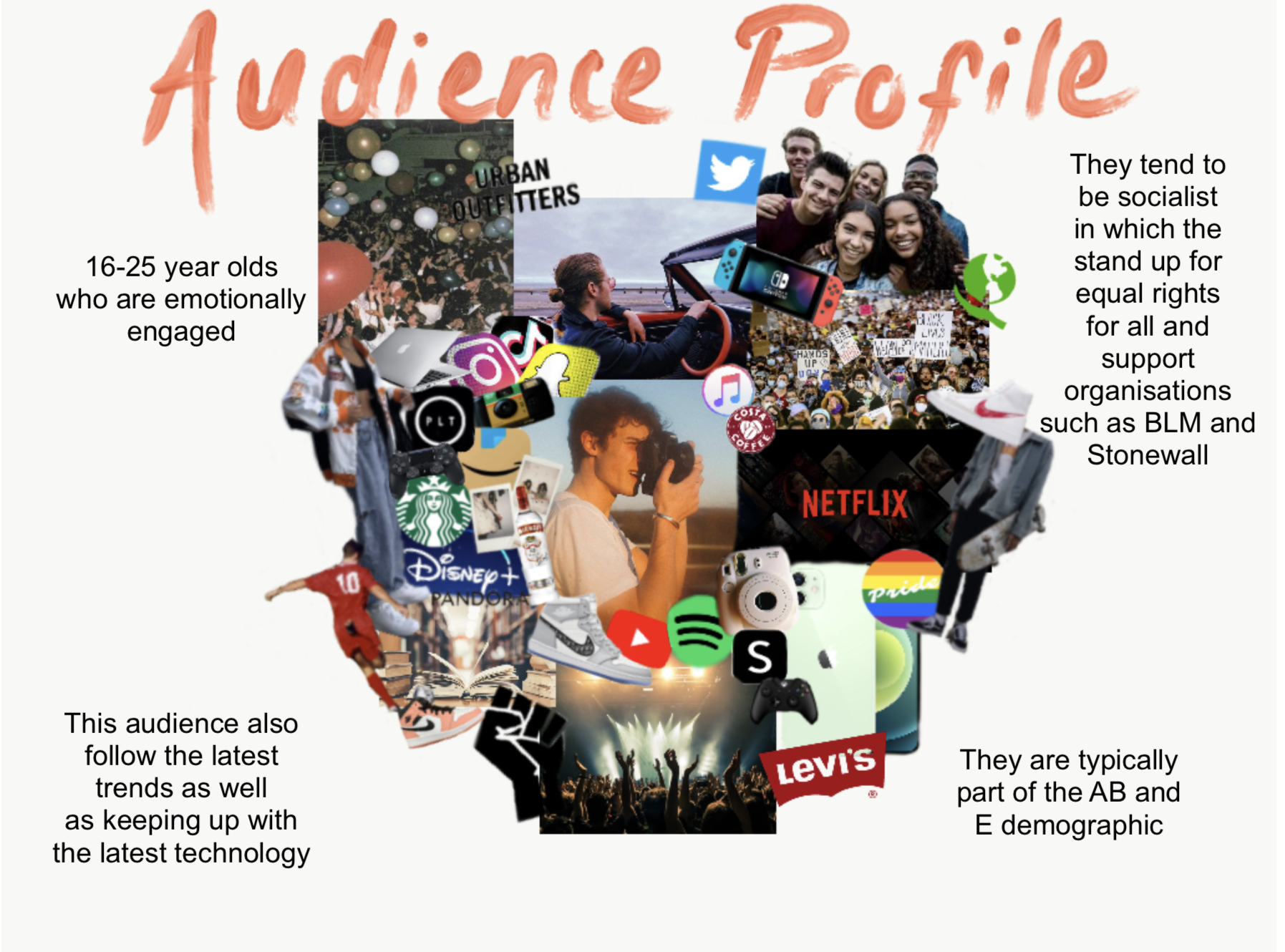
Upon doing audience research I asked the candidates eight questions in order to understand what the customer’s needs and wants are of the specific demongrpahic of 16-25 year olds to ensure that my magazine would be appropriate for the demographic. 


Question 1: How often do you read Magazines?


Amaya: Rarely 

Mitchell: Rarely 

Ashna: Never

Will: Rarely 

Adnaan: Never 

Anwen: Rarely 

Nabil: Sometimes 

Jamie: Never


Question 2: Are you most likely to read a digital or print version of a magazine?


Amaya: Digital 

Mitchell: Print 

Ashna: Digital 

Will: Print 

Adnaan: Digital 

Anwen: Digital

Nabil: Print 

Jamie: Digital


Question 3: What’s your favourite genre of magazine to read? (E.g. fashion, true crime, gossip, TV, etc)


Amaya: Fashion and True Crime 

Mitchell: Gossip, TV, Fashion 

Ashna: Fashion 

Will: Rugby/Sports 

Adnaan: Gaming and Trading 

Anwen: Gossip and True Crime 

Nabil: Motors 

Jamie: Gaming 


Question 4: How much would you pay for a magazine? 


Amaya: £2.51 - £3.50 

Mitchell: £1.50 - £2.50

Ashna: £1.50 - £2.50

Will: £1.50 - £2.50 

Adnaan: £1.50 - £2.50

Anwen: £1.50 - £2.50

Nabil: £2.51 - £3.50 

Jamie: £4.50+


Question 5: What social media platform do you interact with the most?


Amaya: Instagram 

Mitchell: Snapchat 

Ashna: Snapchat 

Will: TikTok 

Adnaan: Instagram 

Anwen: Instagram 

Nabil: Facebook 

Jamie: TikTok


Question 6: Which social media platform are you most likely to read a magazine article on? 


Amaya: Instagram 

Mitchell: Instagram 

Ashna: Snapchat 

Will: Facebook 

Adnaan: Instagram  

Anwen: Twitter

Nabil: Facebook 

Jamie: Instagram 


Question 7: How many magazine companies encourage teenagers and young adults to purchase their products? 


Amaya: Interviews with popular media influencers 

Mitchell: Advertise relevant things for them 

Ashna: Include stuff about teenagers 

Will: Advertise them on social media 

Adnaan: Include discounts on stores teenagers frequently go to 

Anwen: A few discounts on brands 

Nabil: Fashion 

Jamie: Include current trends 


Question 8: What would be your main reason for purchasing a magazine?


Amaya: Entertainment 

Mitchell: If I think it’s interesting 

Ashna: To look at clothes or make up to buy 

Will: For rugby tips 

Adnaan: Entertainment 

Anwen: Interesting title 

Nabil: Bored 

Jamie: Entertainment 


Saturday, 10 April 2021

Top 10 Best-Selling Magazines in the UK

 1.   The National Trust Magazine

Full behind the scenes stories and photography that helps readers to get more from their visits to places in the National Trust

Circulation = 2.4 million

Publisher = National Trust for Places of Historic Interest or Natural Beauty 


2.     Asda Good Living 

Lifestyle magazine with a family focus

Circulation = 1.8 million 


3.     TV Choice 

Includes highlights of all the best programmes, a movie guide and the least east on all soaps 

Circulation = 1.2 million 

Publisher = Bauer


4.     What’s On TV

Guide to UK TV, news, gossip and spoilers about soaps including EastEnders, Coronation Street, Emmerdale and top TV

Circulation = 945,252

Publisher = Future PLC


5.     Radio Times 

The world’s first broadcasting listings magazine when it was founded in 1923, Radio Times is a weekly television and radio programme listings magazine. 

Circulation = 577,087

Publisher = BBC Magazines and Immediate Media Company 


6.     Slimming World 

UK’s best-seller title in the health and diet sector 

Circulation = 560,000


7.     Good Housekeeping 

Monthly women’s magazine featuring articles about women’s interests, products testing by The Good Housekeeping Institute, recipes, diet and health, as well as literary articles

Circulation = 422,000

Publisher = Hearst Corporation 


8.     Stylist 

Free women’s magazine as a complement to ShortList

Circulation = 404,000

Publisher = ShortList Media Ltd/The Stylist Group


9.     Take a Break

Branded as Britains best-selling women’s magazine, true life stories, as well as women’s health and lifestyle features, puzzles and competitions 

Circulation = 416,695

Publisher = Bauer


10.  Woman’s Weekly

A weekly magazine for women, which focuses on the home, family and lives of grown up women, providing them with health advice.  Featuring beauty and fashion advice which is age-relevant.

Circulation = 227,000

Publisher = Future Plc 

Industrial Context: Bauer Media

Bauer Media:

Bauer Media is a privately owned business that is the known for being the UK’s number one magazine publisher and the number one digital commercial audio broadcaster. It was founded in 19875 with now 200 million consumers worldwide and operates in 13 countries including the Czech Republic, Denmark, Finland, France, Germany, Israel, Norway, Poland, Slovakia, Spain, Sweden, UK and USA and has 15,000 employees. 

It is also an entertainment network of iconic and innovative multi-platform brands reaching 25 million consumers using insight and instinct to tell stories that are relevant to audiences and advertisers alike delivering cultural impact. No other media owner has the range and diversity of brands and audiences that Bauer has, it has cultural connections with audiences that makes Bauer different. 

They use audience insight to get a deep understanding of their audiences as they feel it is no longer enough to understand what consumers are doing right now but to understand where behaviours, values and attitudes are changing. To do this Bauer strives to create a culture in which diversity is appreciated and supported, where opportunities are open to all where people treat each other with respect and get the same in return. They want their culture to support the highest standards if behaviour everywhere. 


What they offer:

SME Services:  

Offering marketing and lead generation as a service

Digital technology offers SME services to grow and flourish. As commerce moves online, more people set up digitalised small businesses, digital marketing and sales expertise are increasingly needed to reach customers. 


Audio:

Reaching over 55 million listeners weekly

Bauer Media operates over 110 audio brands in seven countries, spanning the UK, Poland, Slovakia, Denmark, Sweden, Finland, and Norway. Their mission is to “make our listeners world sound better”

They are also growing their podcasts which currently includes popular series such as The Empire Film Podcast, The Frank Skinner Show, Superscoreboard and the Pilot TV Podcast 


Online comparison platforms: 

Bauer Media Group holds market-leading positions

In online comparison in seven European countries, operating platforms for users to compare insurance, personal finance, telecommunication and energy services. 10 million people trust their OCP brands to save time and money when making purchasing decisions 


Publishing:

From women’s magazines to TV listings to food and special interest, they create some of the most popular publishing brands in Germany, UK, Poland, France and the US. Over 400+ titles and 100+ digital products entertain, inform and inspire audiences of all ages 


M&A, investing in future success:

Bauer media also invest in young and complementary business models, that they course for a successful future

They actively look for interesting acquisition opportunities in each of their four business areas and 


Industrial Context: Financing, Distribution and Exchange

Friday, 9 April 2021

Magazine Timeline

Planning : Reflection on Moderator’s Report

 Magazines:

1.     Promote and reinforce brand identity 

2.     Clear sense of branding across the two elements Of the cross media production 

3.     Aesthetic being carried across both editions of the magazine, including the context pages and the websites

4.     Not relying on standard body-text fonts to create sell lines or the masthead and showed control in terms of size and leading

5.     Variety of images on the contents, with anchoring them to the written contents and appropriately laid out and sized text 

6.     Do not use place holder style guides, they must be fully replaced by the candidates own text and graphic 

7.     Question normative gender stereotypes 

8.     Adhere to the codes and conventions of the form and include the key elements from the brief including production detail 

9.     Specifically address the demographic and make sure to have focus on the topic 

10.  References to the website with also linking cover lines to the content pages 


Online Products:


1.     Go beyond the brief, in terms of the amount of material included, in visuals and copy

2.     Best sites exhibited effective, bespoke photography and copy, often capturing a tone appropriate to the needles o the intended audiences with a degree of sophistication being clear (as well as wide range of representation)

3.     Original backgrounds and labour elements that showed a degree of creativity 

4.     Consistent Branding 

5.     Replicate the style and content of the magazine and a range of images and issues indicated by the magazine 

6.     Add creative audio-visual material including make overs, video look books and interviews with designers

7.     Example of tweets, or Instagram posts, a newsletter, example of merchandise for the brands, or discussion of other products available to buy 

8.     Links between the two products needed to be stronger than just placing the product on the website and limiting social media in order 

9.     Even pages with visible menu bar 

10.  Relevant media industry context 


Digital Convergence:


1.     Mention the website 

2.     Link it directly to other products 

3.     Logo on website must match those on other products

4.     Use the Sam models 

5.     Mention the features of for example the website in other products 

6.     Coherent branding and synergy effectively engaging and giving sustained and insightful meaning for the audience across both products 

7.     Use of imagery/logo/models/colours/themes across products clearly demonstrated tha the overall branding had been considered 

8.     Use of cross-media links

9.     Consideration fo how to interact with the target audience 

10.  Develop further than shared fonts and colour schemes 

NEA Brief : Magazines


Wednesday, 24 March 2021

Richard Dyer Star Theory


Andrew Goodwin Music Video Theory


Applying Andrew Goodwin’s theory, I intend to base some of the visuals illustrating the lyrics of the song. Also, there could possibly be the reference to the notion of looking through screens within screens which would be portrayed by shots of a television screen to demonstrate how the audience would be viewing a collective of memories of the couple. As well as this, I intend on incorporating some intertextuality through either band t-shirts or buy distributing vinyl covers in the set locations of the music video. 

Music Industry Streaming Services

Major Players in the Music Video Industry:

  •         Universal Music Group, owns 29.85% of the market
  •         Sony Music. Entertainment, owns. 29.29% of the market
  •         Warner Music Group, owns 19.13% of the market
  •         Independent Labels, owns 12.11% of the market
  •         EMI Group , own 9.62% of the market 

This info graphic shows how streaming services have become more popular overtime. Therefore, it is explaining how technology has changed the way audiences consume media products. In this case 45% of audiences use digital streaming services with YouTube being the most popular platform, having 820 million followers. This suggests in order for music videos to be relatively successful, music companies such as the UMG and Sony Music distributing their products through online platforms would allow for maximum profit for both the artist and the company. 

From viewing this info graphic, producing a music video and uploading it to YouTube would be the most accessible place for the target audience to view the product. As well as this, audiences would be able to produce feedback through the comments section and the like button, which reinforces Shirky’s end of audience theory of how audiences are now becoming more active on the internet.  

Monday, 22 March 2021

Timeline of Music Videos

1926

The talkies were introduced, this involved musical short films featuring bands, vocalists and dancers 


1930

Screen songs ere introduced. This clouded a series of cartoon films which encouraged audiences to sing along by following a marker 


1963

The first appearance of music videos. One of the earliest videos of a top 40 hit, was Jan and Dean’s “Surf City”


1964

The Beatles became one of the most famous boy bands in the world with their modern music video for ‘A Hard Days Night’, which was shot in black and white 


1975

The long running British TV show Top of the Pops began playing music videos in the late 1970s. Therefore, a good video would increase a song’s sales as viewers hoped to see it again the following week. The band Queen ordered Bruce Gowers to make a promo video for their new single ‘Bohemian Rhapsody” to shoe it in Top if the Pops; this is also notable for being entirely shot and deities on videotape 


1981

The music channel MTV was created. This enabled music videos to play a central part in music marketing by mid 1980s. It began an ear of 24 hour a day music on television


1984

Michael Jackson released his music video,‘Thriller’ which proved to be a big hit. It was the most successful, influential and iconic music video of all time. It was nearly a 14 minute long video.


1985

The music channel VH1 was launched. This featured a range of soft music to suit an older audience helping to broaden the audience of music videos. Music videos grew to play a central role in popular music marketing. Many important acts of this period such as Madonna and Adam and the Ants, owed a great deal of their success to the skilful construction and seductive appeal of their videos


1988

Hip Hip music began to increase in popularity 


1992

MTV began to show the director names in the credits of music videos, reflecting the fact that music videos has increasingly become an auteur’s medium. Directors such as Michel Gondry, Spike Jonze and Hype Williams all bought unique visions and style to the videos they directed 


1995

Michael Jackson’s music video ‘Scream’ becomes one of the most expensive music videos, costing a total of 7 million dollars to create 


2005

iTunes opened allowing people to download their favourite tracks from the computer. The online entertainment website ‘YouTube’ was created enabling music lovers to access their favourite music videos online. This resulted in an increase of new artists. MTV and many of its sister channels had largely abandoned showing music videos in favour of reality tv shows, which were more popular with its audience 


2010

The number of music videos viewed online begins to massively increase. Lady Gag’s music video ‘Poker Face’ reaches one billion views 

Monday, 8 March 2021

Audience Research: Focus Group

Primary Audience 


AMAYA CONWAY 

Age: 16

Gender: Female 

Race: Hispanic White 

Location: Thorpe Bay, England 

Psychographic: Mainstreamers and Succeeders 

Interests: Reading, Baking, Singing 

How often do you watch music videos: A lot 

What do you like most about music videos: The story that’s shown 

What platform do you listen to music on: Spotify 


MITCHELL ROGERS

Age: 17

Gender: Male 

Race: White 

Location: Eastwood, England 

Psychographic: Explorers, Strugglers, Reformers    

Interests: Music, Rugby, Parties, Superheroes 

How often do you watch music videos: From time to time 

What do you like most about music videos: Give more of an insight to the lyrics of the song and what they may represent to the artist. They 

show how the artist feels when writing a song or what they

went through to create their song

What platform do you listen to music on: Spotify 


ASHNA KHODABUX 

Age: 20

Gender: Female 

Race: Brown 

Location: Exeter, England 

Psychographic: Explorers and Reformers 

Interests: Art, Jewellery Making, Shoes

How often do you watch music videos: Rarely 

What do you like most about music videos: When there is a story line

What platform do you listen to music on: Spotify 


WILL WILSON 

Age: 20

Gender: Male 

Race: White 

Location: Wales 

Psychographic: Reformers and Mainstreamer 

Interests: Rugby, Gym, Cars 

How often do you watch music videos: Never 

What do you like most about music videos: Does not 

watch music videos 

What platform do you listen to music on: Spotify 


ADNAAN KHODABUX

Age: 22

Gender: Male 

Race: Brown  

Location: Southend-On-Sea, England

Psychographic: Reformer 

Interests: Gaming 

How often do you watch music videos: Rarely 

What do you like most about music videos: Girls

What platform do you listen to music on: iTunes 


ANWEN SLEATH

Age: 20

Gender: Female 

Race: White 

Location: Exeter, England / Wales 

Psychographic: Succeeders and Explorers 

Interests: Documentaries, Fashion, Art, Socialising 

How often do you watch music videos: Not Often, only watch them if they are popular or if it’s the music I like  

What do you like most about music videos: The aesthetics, likes to visualise the song 

What platform do you listen to music on: Spotify 


Secondary Audience 


NABIL BACHRI
Age: 44

Gender: Male 

Race: Brown

Location: Southend-On-Sea, England 

Psychographic: Succeeders

Interests: Music, Sports and Cars 

How often do you watch music videos: From time to time 

What do you like most about music videos: The storyline and the outfits 

What platform do you listen to music on: YouTube


JAMIE VINCENT 

Age: 13

Gender: Male

Race: British White

Location: Southend-On-Sea

Psychographic: Mainstreamer

Interests: Gaming and Drawing 

How often do you watch music videos: Never 

What do you like most about music videos: The Music

What platform do you listen to music on: Spotify 

Wednesday, 3 March 2021

Planning: Reflection on moderators report

Music Video:

1. Clear focused research, detailed planning, attention to detail and a strong, sustained central concept based solidly on the requirements and details of the brief, as reflected in focused, unambiguous Statements of Intent

2. Make sure there is an excellent level of convergence and synergy across both products

3. Follow conventions and create messages through by example the costumes 

4. There had to be a clear sense of branding across the two elements of the cross-media production

5. The best work emphasised the performance aspect, filming the artist performing the track a number of times in different locations with different mise-en-scene and utilising a variety of camera shots and movement

6. Make sure editing matches the pace of the track

7. Show clearly how two social groups are represented

8. Don't use simplistic narratives, consider the content/mood/tone of the track 

9. Videos of actors holding hands walking away from the camera should be avoided 

10. Vertical mobile footage should be avoided at all costs 

Online Products:

1. Go beyond the brief, in terms of the amount of material included, in visuals and copy 

2. Best sites exhibited effective, bespoke photography and copy, often capturing a tone appropriate to the needs of the intended audience, with a degree of sophistication being clear (as well as a wide range of representations)

3.  Original backgrounds and layout elements that showed a degree of creativity

4. Consistent Branding 

5. Build the website around the artist, not the song

6. Links between the two products needed to be stronger than just placing the product on the website and listing social media in order

7. Examples of tweets, or Instagram posts, a newsletter, examples of merchandise for the brand, or discussion of other products available to buy such as tracks, tour books, subscriptions 

8. Even pages with visible menu bar 

9. Relevant media industry context in this case, Universal Music Group 

10. Produce own contents 

Digital Convergence: 

1. Mention the website 

2. Link it directly to other products 

3. Logo on website must match those on other products 

4. Use the same actors/models in both products

5. Mention the features of for example to website in the other product 

6. Coherent branding and synergy effectively engaging and giving sustained and insightful meaning for the audience across both products 

7.  Use of imagery/ logo/ models/ colours/ themes across products clearly demonstrated that the overall branding had been considered 

8. Use of cross-media links

9. Consideration of how to interact with the target audience 

10. Develop further than shared fonts and colour schemes 

Link to Website

  https://ayaahbachri15.wixsite.com/mitchellrogers1